
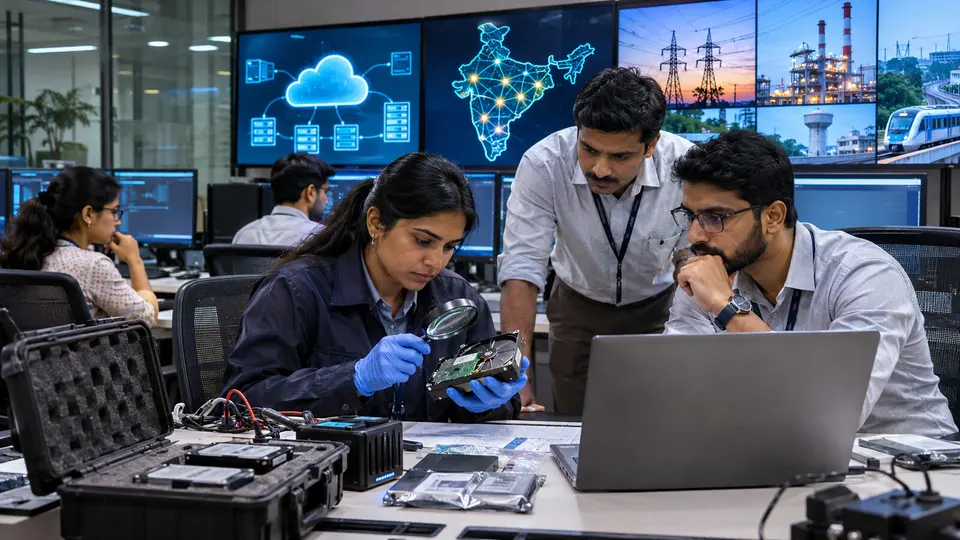
India’s third National Conference on Cyber Security, Digital Forensics and Intelligence has brought government, academia and industry into an applied programme covering emerging threats and operational response.
The two-day NCCDFI 2026 event includes seven technical sessions, more than 30 speakers and 12 industry partners. NIELIT said memoranda of understanding were signed to encourage institutional partnerships and practical outcomes.
Cybersecurity is moving beyond the IT department
The programme covers artificial-intelligence-driven threats, digital forensics, critical-infrastructure protection, cyber intelligence, incident response, blockchain and cloud security, digital evidence, cyber law and emerging technologies.
Those topics reflect how cyber risk now affects banking stability, public trust, law enforcement and essential services. An attack can create operational disruption, legal exposure and supply-chain effects even when a company’s own systems are not the initial target.
Digital forensics is particularly important because organisations need evidence that can survive regulatory, contractual or legal scrutiny. This requires disciplined collection, preservation and analysis, not only security monitoring.
Partnerships need measurable outputs
Conferences can improve coordination, but their value depends on what follows. Useful outcomes would include shared training, tested incident-response exercises, interoperable forensic methods and research that can move into operational tools.
For businesses, the practical message is to connect technology teams with legal, risk, compliance and senior management. Incident plans should identify decision rights, external specialists, notification triggers and the evidence needed to reconstruct events.
AI creates a two-sided challenge. Attackers can automate reconnaissance and convincing social engineering, while defenders can use models to detect anomalies and prioritise investigations. Both uses require human oversight and validation.
The release does not provide the terms or funding attached to the announced partnerships. Their impact will become clearer when participating institutions publish projects, milestones and adoption results.
Source: Ministry of Electronics and IT via PIB, 16 November 2026.
This article is journalism and commentary. It is not a recommendation to buy or sell any security, and it is not professional advice. Read the full disclaimer.