
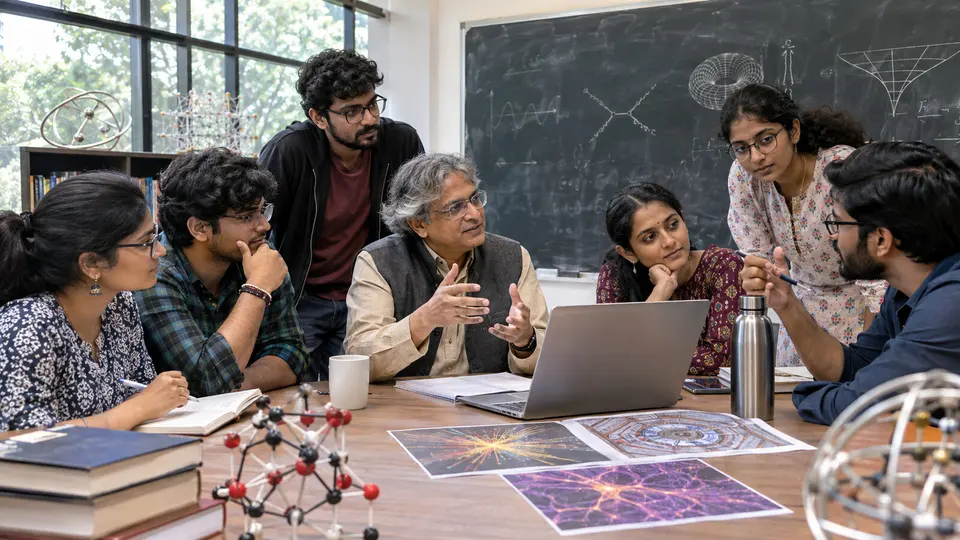
India’s Department of Science and Technology and the International Centre for Theoretical Physics have initiated an India–ICTP Co-operation Fund intended to give Indian researchers more structured access to international collaboration and mobility programmes.
The two institutions exchanged a letter of intent during an Indian ministerial visit to ICTP in Trieste, Italy. The announcement does not specify the fund’s size, launch date or selection rules, so its immediate financial scale cannot yet be assessed.
Mobility can widen access to specialist infrastructure
ICTP supports advanced research and training in physics, mathematics and related fields. Indian scientists already participate in its visiting fellowships, diploma programmes, postdoctoral opportunities, workshops and collaborative research.
The new framework is expected to build on work involving DST, the Council of Scientific and Industrial Research, universities and Indian Institutes of Technology. Areas of engagement include high-energy physics, astrophysics, climate modelling and computational science.
Research mobility can give scientists access to specialist peers, methods and facilities that are difficult to reproduce within a single institution. Returning researchers can transfer those capabilities into Indian laboratories, teaching programmes and technology ventures.
The business effect is indirect but important. Fundamental science supplies skills and knowledge that later support areas such as advanced materials, semiconductors, climate technology, scientific computing and precision instrumentation. Stronger international networks can also help Indian teams join larger research consortia.
Design will determine who benefits
A cooperation fund becomes meaningful only when researchers can understand its eligibility, funding level and application schedule. Transparent selection, support for early-career scientists and representation beyond a small group of established institutions would broaden its impact.
Mobility programmes also need mechanisms for knowledge to circulate after a visit. Joint publications, open seminars, shared datasets and follow-on grants can turn individual placements into durable institutional capacity.
The letter of intent establishes direction rather than a completed programme. The next useful disclosures will be the financial contributions, governance structure, number and duration of placements, and how outcomes will be measured.
Source: Department of Science and Technology via PIB, 15 November 2026.
This article is journalism and commentary. It is not a recommendation to buy or sell any security, and it is not professional advice. Read the full disclaimer.