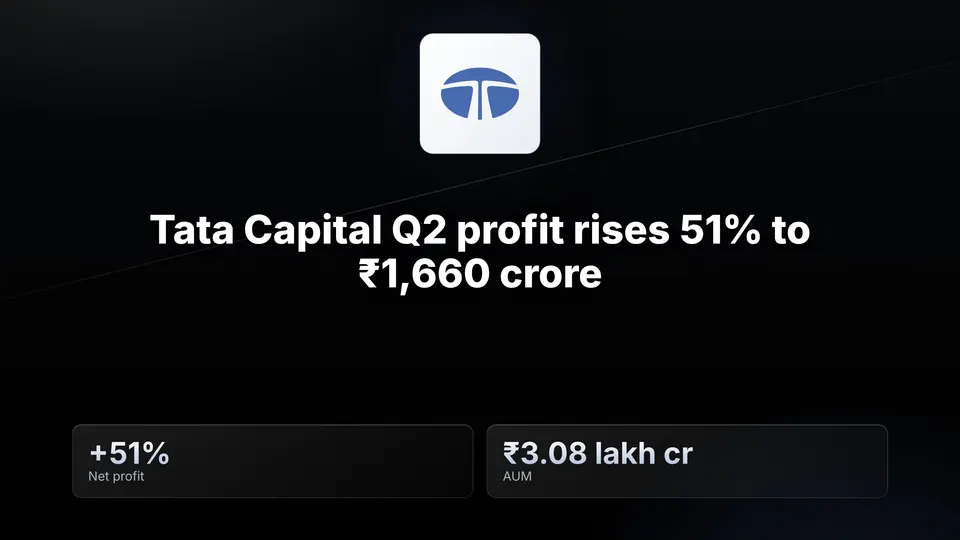
Tata Capital reported a consolidated net profit of ₹1,660 crore for the quarter ended 30 September 2026, up 51% from ₹1,097 crore a year earlier, according to Business Standard's report of 27 October 2026. Net total income rose 24% to ₹4,676 crore from ₹3,774 crore. Spectate Media has not seen the company's filing and relies on that report.
Loan book
Assets under management reached ₹3,08,030 crore, up 26% year on year. Chief executive Rajiv Sabharwal said the loan book crossed ₹3 trillion, underscoring the scale, diversification and resilience of the franchise. The company operates 1,515 branches across 26 states and Union Territories.
Asset quality
Sabharwal said asset quality remained stable, reflecting a focus on portfolio quality, prudent underwriting and effective collections. The report gives no gross or net NPA figures, so that claim cannot be checked from it.
Borrowing plan
The board approved raising the company's medium-term note programme from $2 billion to $3 billion. Subject to market conditions, the company may issue foreign currency bonds or other debt instruments under the programme through external commercial borrowings.
How the numbers compare
On the reported figures, profit grew about twice as fast as net total income (51% against 24%), while assets under management grew 26%. The report does not say whether that gap came from lower credit costs, lower expenses or other items, so Spectate Media draws no conclusion on the cause.
Market reaction
Shares closed 0.45% higher at ₹300.80 on the BSE.
What to watch
The report does not cover margins, expenses, provisions or earnings per share, which would show how much of the profit growth came from lending spreads and credit costs. Asset-quality numbers and the pace of the new borrowing are the points to track. Not investment advice.
Source: Business Standard, 27 October 2026. This is a summary of a news report, published as general information. It is not legal, tax or investment advice.
This article is journalism and commentary. It is not a recommendation to buy or sell any security, and it is not professional advice. Read the full disclaimer.