
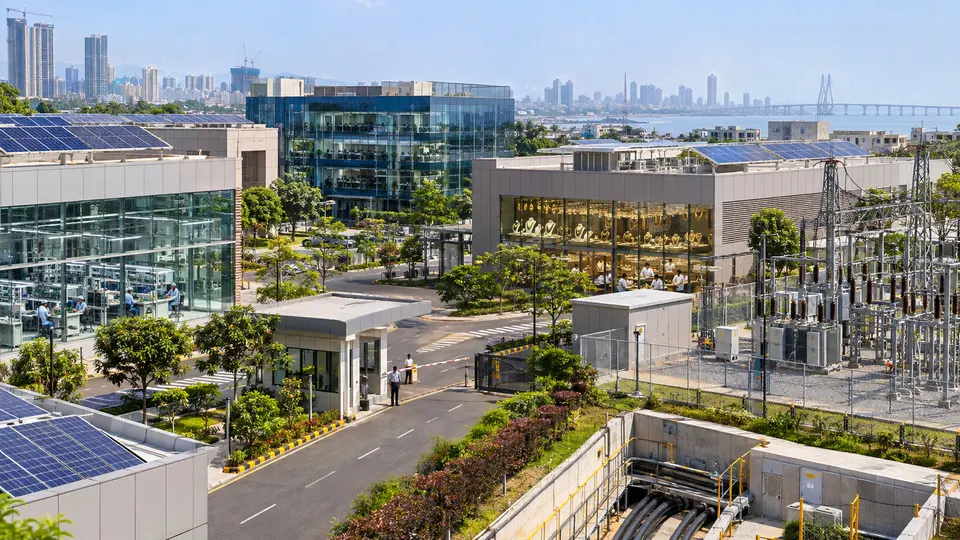
Mumbai’s Santacruz Electronic Export Processing Zone has moved to 100% green electricity and reduced its power tariff to ₹5.60 per unit, compared with ₹8.65 outside the zone, giving jewellery, electronics and information-technology exporters a lower operating-cost base.
The revised structure covers 495 electricity consumers, including 243 operating units and other utilities. SEEPZ said the arrangement delivered ₹32.5 crore in electricity-cost savings during 2025-26 and could raise annual savings to ₹54 crore by 2029-30 at current consumption levels.
A distribution change behind the savings
The lower tariff follows the appointment of Adani Electricity SEEPZ Limited as a co-developer for power distribution. The framework became operational in November 2023, while a revised tariff approved by the Maharashtra Electricity Regulatory Commission took effect in April 2025.
The zone has received 100% green electricity since July 2026. This makes the change relevant beyond the immediate tariff benefit: exporters increasingly face customer and supply-chain expectations on the carbon intensity of production.
Infrastructure has to keep pace
SEEPZ’s distribution system includes 48 substations with aggregate capacity of 53 MVA and around 30 kilometres of underground cabling. Current power demand is about 35–40 MW, but redevelopment under SEEPZ 2.0 is expected to lift the requirement to 70–80 MW.
The authority has installed solar plants at the Mega Common Facility Centre and NEST-1, with further rooftop capacity planned for NEST-2 and other buildings. Battery energy-storage systems approved by the state regulator are also planned, alongside additional substations.
Key operating numbers
- SEEPZ tariff: ₹5.60 per unit
- Comparable outside tariff: ₹8.65 per unit
- Consumers covered: 495
- Operating units: 243
- FY2025-26 savings: ₹32.5 crore
- Projected FY2029-30 annual savings: ₹54 crore
- Current demand: 35–40 MW
- Expected demand after redevelopment: 70–80 MW
What export businesses should watch
Lower electricity costs can improve margins in power-sensitive manufacturing and services, but the benefit depends on reliable supply as the zone expands. Operators should monitor outage performance, tariff revisions and how quickly new substations and storage capacity are commissioned.
Exporters can also use verified green-power sourcing in customer disclosures, subject to the documentation required by buyers and carbon-accounting standards. The commercial value will be greatest where energy provenance is traceable rather than treated only as a marketing claim.
For the zone authority, the test is whether distribution capacity grows ahead of demand. A near doubling of load without timely infrastructure additions could dilute the reliability gains that accompany the lower tariff.
The economics also depend on maintaining the green-power supply as demand rises. New rooftop solar can contribute locally, but the larger requirement will still need contracted generation, network capacity and storage or balancing arrangements. Buyers should therefore separate the current achievement from the investment needed for the next stage.
For other industrial parks, SEEPZ offers a model worth examining rather than a tariff that can be copied automatically. Savings will vary with local regulation, consumer mix, distribution losses and the cost of renewable procurement.
The initiative is sector-wide and does not represent a company earnings announcement or an immediate change to electricity prices across Mumbai.
Source: Ministry of Commerce and Industry release published by the Press Information Bureau on 5 November 2026.
This article is journalism and commentary. It is not a recommendation to buy or sell any security, and it is not professional advice. Read the full disclaimer.