
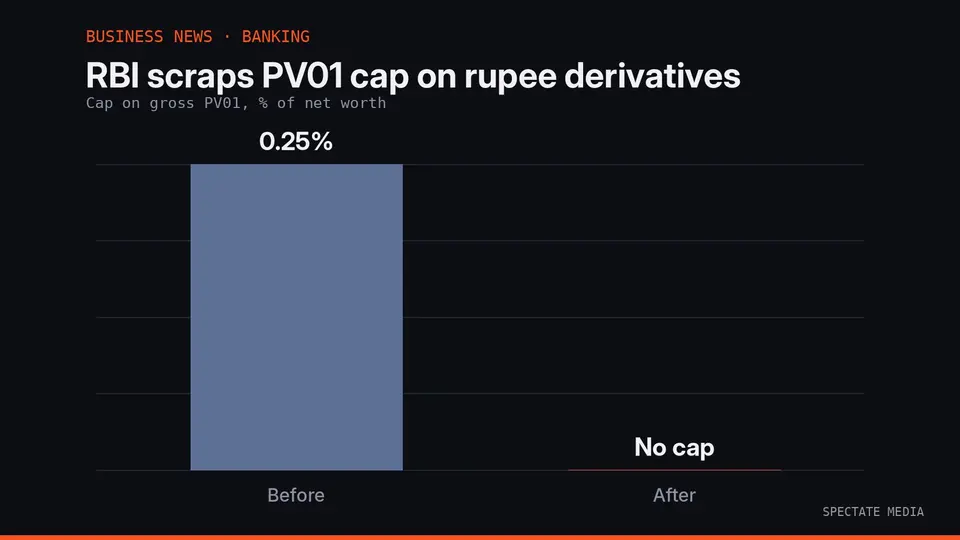
The Reserve Bank of India on 19 October 2026 removed the limit on how large a bank's non-option rupee derivative positions can be, according to a Corplawupdates summary of two circulars. Both took effect on issuance. Spectate Media has not checked the circulars themselves.
What changed
Circular RBI/2026-27/294 amends the directions for commercial banks and RBI/2026-27/295 those for small finance banks, both under Section 35A of the Banking Regulation Act, 1949. Each deletes paragraph 37, which required the gross PV01 of all non-option rupee derivative contracts, including rupee-foreign currency contracts, to stay within 0.25% of a bank's net worth at its last balance sheet date. PV01, the change in value for a one basis point move in rates, was a measure of interest-rate exposure. Hedges that qualified as effective balance-sheet hedges were already excluded from the cap. No replacement cap is introduced.
What still applies
The cap covered forwards, swaps and rupee-foreign currency contracts; option contracts were never subject to it, and the paragraph on deferring option premium is unchanged. Banks remain subject to their board-approved market-risk limits, counterparty exposure norms, market-risk capital requirements, other RBI derivative directions and hedge-effectiveness standards.
Reason given
The notifications say only that the change follows a review and is in the public interest. The summary's view that the RBI is relying more on banks' internal risk frameworks is its own interpretation.
Key numbers
- Previous cap: 0.25% (Of net worth, on gross PV01)
- Replacement cap: None (Paragraph 37 deleted)
- Applies to: 2 bank types (Commercial and small finance banks)
- Effective: 19 Oct 2026 (On issuance)
What boards and CFOs should note
Three points stand out. First, banks no longer have a fixed regulatory ceiling on this exposure, so internal limits become the main control. Second, treasury teams should update limit-monitoring systems and policies that cite paragraph 37. Third, boards of affected banks should confirm that their own market-risk limits are set at a level they are comfortable with.
Source: Corplawupdates, 19 October 2026. This is a summary of a news report, published as general information. It is not legal, tax or investment advice.
This article is journalism and commentary. It is not a recommendation to buy or sell any security, and it is not professional advice. Read the full disclaimer.