Two large steelmakers reported higher volumes for the September 2026 quarter on 23 October. JSW Steel said it had its highest-ever quarterly crude steel production and saleable steel sales, and Jindal Steel's sales volume rose 27% from a year earlier, according to Business Standard. Spectate Media has not seen either filing.
JSW Steel
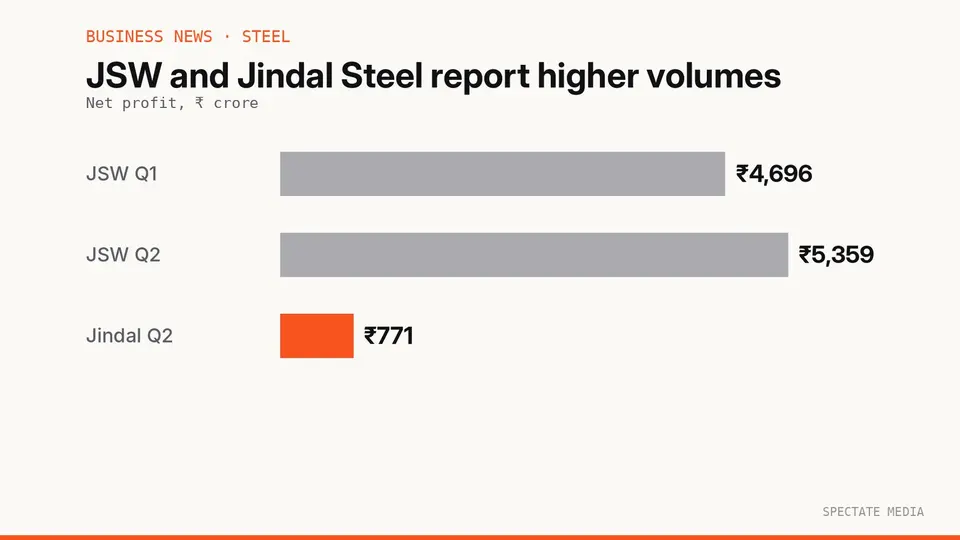
Consolidated profit after tax was ₹5,359 crore, up 14.1% from ₹4,696 crore in the first quarter, and revenue was ₹54,486 crore, up 15% from ₹47,364 crore. Reported EBITDA was ₹10,120 crore, up 8% from ₹9,383 crore. A Free Press Journal headline puts consolidated crude steel production at 7.27 million tonnes, up 10% on the previous quarter; Spectate Media has not seen the full article. The Business Standard report gives no year-on-year comparison, no realisation per tonne and no capex plan.
Jindal Steel
Consolidated net profit was ₹771 crore. Business Standard calls that a rise of more than 21%, but the year-ago figure it gives, ₹1,646 crore, would mean a fall of about 53%. The same ₹1,646 crore appears as JSW Steel's year-ago profit in other reports, so Spectate Media does not use the profit comparison. Total income was ₹15,289.20 crore, up 26%, and gross revenue was ₹19,448 crore, up 44% from a year earlier and 9% from the previous quarter. Production was 2.40 million tonnes, flat on the quarter and up 20% on the year. Sales were 2.38 million tonnes, up 27%, helped by inventory liquidation, and 92% of sales were domestic. Net debt fell to ₹14,786 crore from ₹15,927 crore at the end of June, and net debt to EBITDA improved to 1.51 times from 1.71 times. Capex was ₹1,228 crore, and the company commissioned a 192-kilometre iron ore slurry pipeline from Barbil to Angul.
Key numbers
- JSW Steel profit: ₹5,359 crore (Up 14.1% on Q1)
- JSW Steel EBITDA: ₹10,120 crore (Up 8% on Q1)
- Jindal Steel sales volume: 2.38 million tonnes (Up 27% on a year ago)
- Jindal net debt: ₹14,786 crore (From ₹15,927 crore in June)
What boards and CFOs should note
Three points stand out. First, both companies are growing volumes, which the reports link to production and sales, not to a single price move. Second, Jindal's gain came partly from inventory liquidation, which cannot be repeated indefinitely. Third, the conflicting year-ago profit figure is a reminder to check comparisons against the filing.
Source: Business Standard, 23 October 2026 (JSW Steel). This is a summary of a news report, published as general information. It is not legal, tax or investment advice.
This article is journalism and commentary. It is not a recommendation to buy or sell any security, and it is not professional advice. Read the full disclaimer.