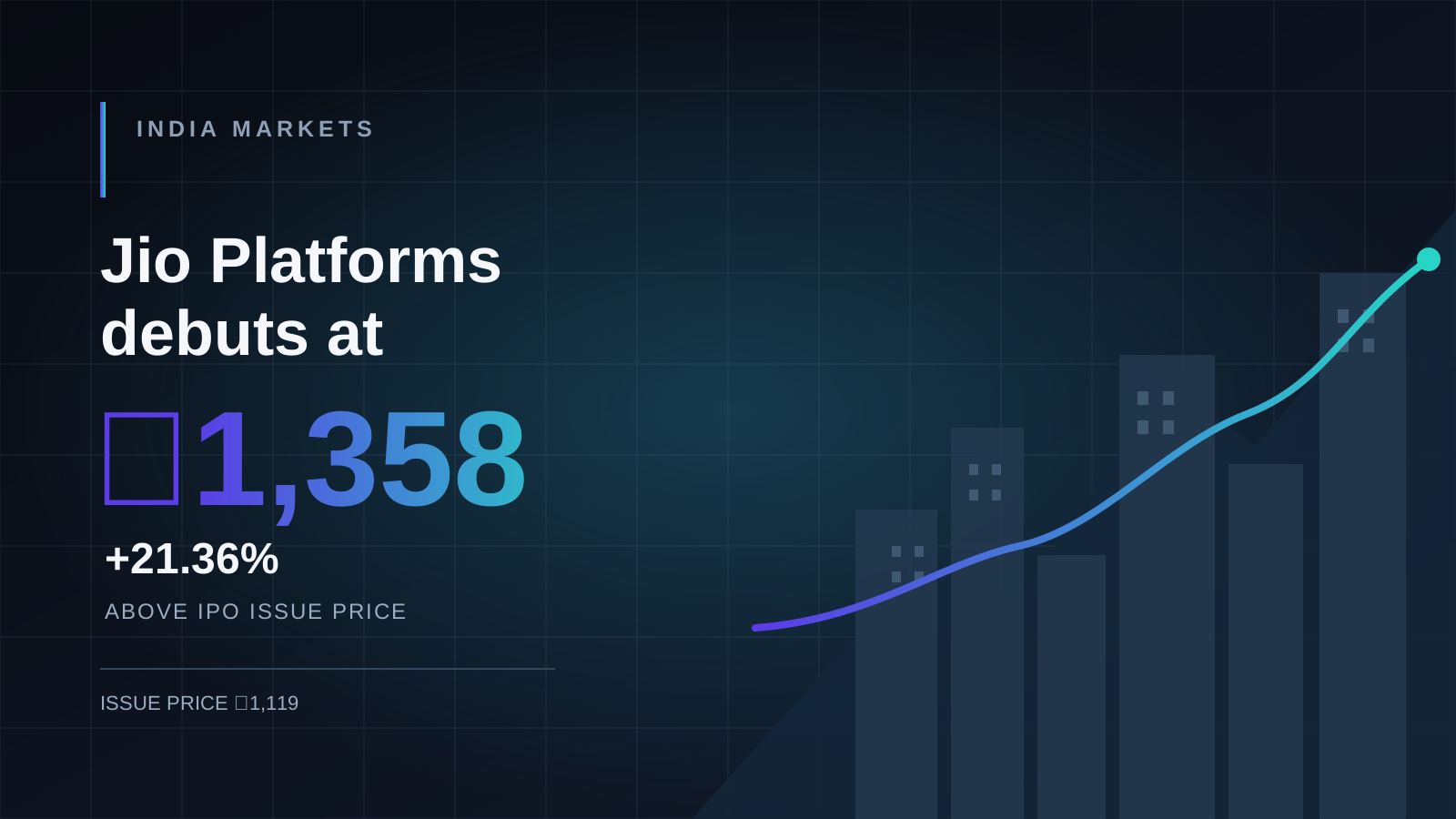
Jio Platforms began trading on the Indian stock market at ₹1,358 a share, 21.36% above its issue price of ₹1,119, according to Business Standard’s listing-day report. The debut placed the company at a reported market value of about ₹12.5 trillion, making it one of India’s most valuable listed businesses.
The company’s initial public offering raised ₹30,213 crore and was subscribed 22.19 times, Business Standard reported. The opening price gives investors a first public-market reference point for the business, but the initial premium alone does not establish how the shares will perform over a longer period.
Listing puts a large valuation into public view
The listing marks a transition from an IPO pricing process to continuous trading in the secondary market. The ₹1,119 issue price reflected the offering terms, while the ₹1,358 opening price reflected demand at the start of trading. Those prices are distinct measures and may change as buy and sell orders interact through the session.
The reported market value of roughly ₹12.5 trillion also gives the debut wider market significance. A company entering the market at that scale can affect investor attention and comparisons across listed businesses. Market capitalisation, however, is calculated from the share price and share count; it is not the same as cash raised in the IPO or a measure of operating profit.
IPO demand was strong
The offering’s reported 22.19-times subscription indicates that applications exceeded the number of shares available across the offer, on the reported aggregate basis. The IPO raised ₹30,213 crore, according to Business Standard. Subscription multiples show demand during the offer period, but they do not guarantee that the share price will remain above the issue price after listing.
The listing premium should therefore be read alongside subsequent disclosures and trading. Investors will receive additional information through the company’s public filings and financial reporting, which provide a basis to assess business performance beyond the first market price.
What the opening price does—and does not—show
A listing price is a snapshot of the market’s opening assessment, not a forecast. Intraday prices can move as new orders enter the market and as investors respond to broader market conditions. The reported valuation can also change with the share price even if the number of shares remains unchanged.
For corporate leaders and market observers, the debut is a notable capital-markets event because of the size of the offering and the valuation reported at listing. It is not, by itself, evidence of future revenue growth, profitability or cash generation. Those questions require ongoing review of disclosed financial and operating information.
Key numbers
- Issue price: ₹1,119 per share.
- Opening price: ₹1,358 per share.
- Listing premium: 21.36% over the issue price.
- IPO proceeds: ₹30,213 crore.
- IPO subscription: 22.19 times.
- Reported market value at debut: about ₹12.5 trillion.
What boards and CFOs should note
- How will the company’s public disclosures help investors evaluate performance beyond the initial listing price?
- Which operating and financial measures will be most useful for assessing the business over successive reporting periods?
- How might changes in the market price affect comparisons with other listed companies, given that market capitalisation can change without a corresponding change in operating performance?
Source: Business Standard, listing-day report: https://www.business-standard.com/amp/markets/news/jio-platforms-share-price-listing-21-premium-becomes-india-s-2nd-most-valuable-firm-126102800274_1.html
This article is for general information only and is not investment advice or a recommendation. Spectate Media has not independently reviewed the company’s full listing-day filings and relies on Business Standard’s report for the figures cited above.
This article is journalism and commentary. It is not a recommendation to buy or sell any security, and it is not professional advice. Read the full disclaimer.