India’s domestic artificial-intelligence stack has gained two new foundation-model families, with the IndiaAI Mission announcing EKA-1 from Soket and Dhir from ZenteiQ. The releases are aimed at Indian-language capability, enterprise deployment and lower-cost access to generative AI.
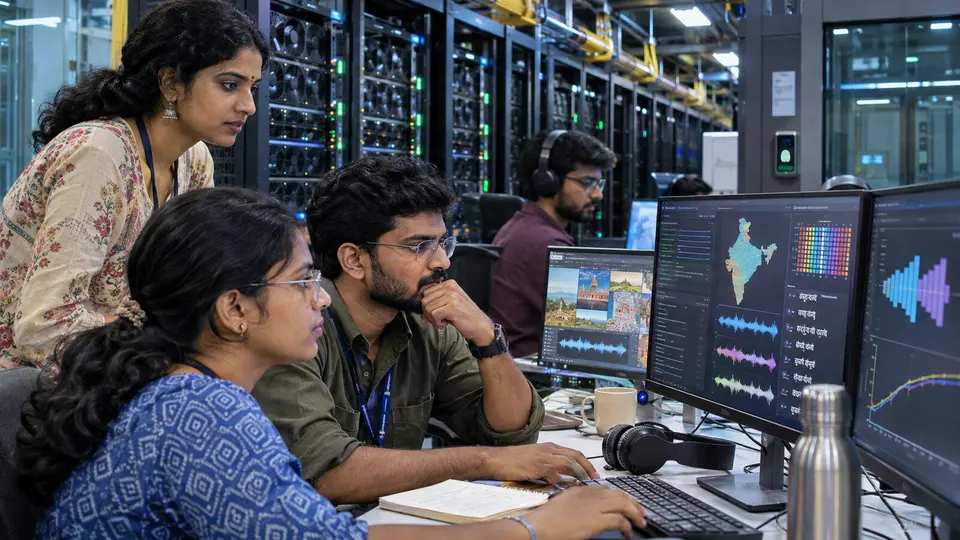
EKA-1 is a 26.3-billion-parameter model trained on about 7.5 trillion tokens. It supports English and the 22 languages listed in the Constitution’s Eighth Schedule, and is designed for tasks spanning mathematics, coding, reasoning and agentic workflows.
Dhir takes a smaller-model route. Its open-source 2-billion and 5-billion-parameter variants support English and 10 Indian languages, with deployment options across GPUs, TPUs and on-device hardware.
Two different routes to adoption
The larger EKA-1 model is positioned for broad multilingual and reasoning workloads. Dhir’s smaller footprint is intended to make private, offline and edge deployments more practical, including for organisations that cannot send sensitive data to a public cloud service.
That distinction matters commercially. Indian businesses are moving from demonstrations to production systems where inference cost, latency, data residency and model governance can outweigh benchmark performance alone.
The IndiaAI compute layer
Both model efforts sit within the IndiaAI Mission, which is using subsidised compute access to lower the cost of training and serving domestic models. Compute availability has been a major entry barrier for smaller AI companies because large training runs require expensive accelerator capacity and specialised engineering.
Public support can shorten the development cycle, but adoption will still depend on independent evaluation, reliable application interfaces, security testing and a sustainable pricing model after subsidies.
Key specifications
- EKA-1: 26.3 billion parameters
- EKA-1 training corpus: about 7.5 trillion tokens
- EKA-1 language coverage: 22 scheduled Indian languages plus English
- Dhir variants: 2 billion and 5 billion parameters
- Dhir language coverage: 10 Indian languages plus English
- Dhir deployment: GPU, TPU and on-device environments
What enterprises should test
Buyers should evaluate accuracy by language and business domain rather than relying on aggregate scores. Important tests include hallucination rates, retrieval quality, code-switching, safety controls, throughput and the total cost per completed task.
For regulated sectors, Dhir’s secure on-premise and offline options may be particularly relevant. However, deployment location does not remove the need for access controls, logging, red-team testing and clear accountability for model outputs.
The announcements expand the choice of India-focused foundation models, but they do not guarantee commercial scale. The next evidence points will be developer uptake, enterprise pilots, documented performance and repeat usage in production.
Language coverage is commercially useful only when models handle regional vocabulary, mixed-language prompts and specialised documents consistently. Banks, healthcare providers and public-service platforms will need evaluations built from their own workflows, including human review by fluent speakers.
The open-source positioning of Dhir can also support customisation by startups and research teams. Yet adopters must inspect licence terms, model provenance and the security of downstream fine-tunes. EKA-1’s larger scale may suit more complex workloads, but it will require careful capacity planning to keep response times and compute bills under control.
Source: Ministry of Electronics and Information Technology release published by the Press Information Bureau on 3 November 2026.
This article is journalism and commentary. It is not a recommendation to buy or sell any security, and it is not professional advice. Read the full disclaimer.