
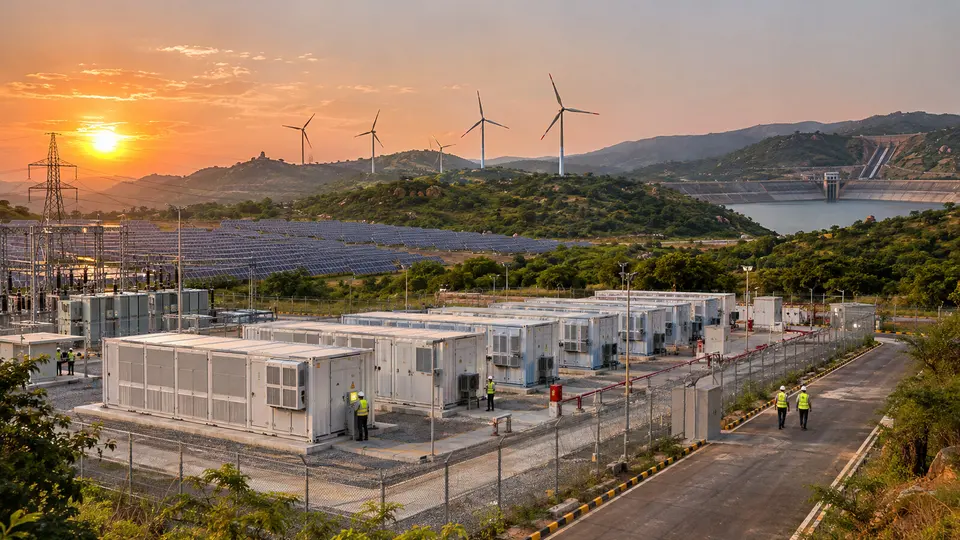
India has approved a ₹14,500-crore viability-gap funding programme intended to catalyse 92 gigawatt-hours of grid-scale energy storage, giving the power sector a new five-year pipeline for balancing a system with rapidly rising renewable generation.
The programme will run from 2026-27 to 2030-31. Of the targeted capacity, 60 GWh is earmarked for pumped-storage projects, 30 GWh for battery energy-storage systems and 2 GWh for alternative storage technologies. The government estimates that the scheme could unlock investment of about ₹97,600 crore.
Why storage has become a system priority
Solar and wind output varies by hour and weather, while electricity demand follows a different curve. Large storage assets absorb surplus power and return it to the grid when demand rises, reducing curtailment and improving reliability.
The official estimate puts India’s storage requirement at 411 GWh by 2031-32. The new scheme therefore addresses only part of the projected need, leaving room for state tenders, merchant projects and additional central programmes.
How the support will work
Projects will be selected through competitive bidding, with viability-gap support designed to narrow the difference between project cost and the tariff the market can bear. The programme covers established pumped hydro and battery technologies while reserving a smaller window for newer approaches.
Battery projects supported by the scheme must meet a 40% domestic-content requirement. That condition could influence supplier selection and encourage local manufacturing of eligible components, although project developers will still need to manage technology, warranty and raw-material risks.
Key numbers
- Government support: ₹14,500 crore
- Target capacity: 92 GWh
- Pumped storage: 60 GWh
- Battery storage: 30 GWh
- Alternative technologies: 2 GWh
- Estimated investment: ₹97,600 crore
- Scheme period: FY2026-27 to FY2030-31
What boards and lenders should watch
For developers, the decisive details will be tender design, payment security, discharge obligations and the allocation of construction and hydrology risks. Pumped-storage projects have long development cycles and site-specific approvals, while batteries face degradation and replacement-cost questions.
For equipment makers, the domestic-content rule creates a clearer demand signal but also raises the importance of certification and supply-chain traceability. Utilities and large power buyers will need to compare storage contracts with alternatives such as flexible generation, transmission expansion and demand response.
The programme is a sector-level commitment rather than an immediate award of 92 GWh. Actual deployment will depend on tender schedules, project clearances, financing and commissioning performance.
State distribution companies and renewable developers will also watch how storage is contracted. A project paid mainly for capacity has a different risk profile from one exposed to daily power-price spreads. Clear rules for charging energy, grid connection and availability will determine whether bids remain financeable after the initial competition.
The technology split gives the market more than one route to scale. Pumped hydro can provide long-duration storage, while batteries can be installed faster and closer to load centres. The small alternative-technology allocation creates a test bed without making the wider programme dependent on unproven systems.
Source: Ministry of Power release published by the Press Information Bureau on 4 November 2026.
This article is journalism and commentary. It is not a recommendation to buy or sell any security, and it is not professional advice. Read the full disclaimer.