
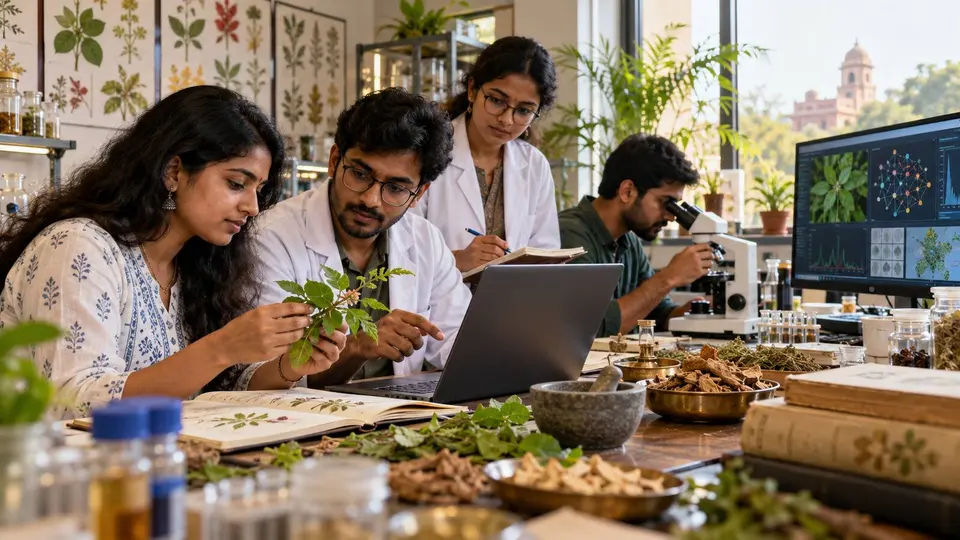
The All India Institute of Ayurveda has launched a national open challenge for artificial-intelligence applications in Ayurveda, bringing together Techfest at IIT Bombay, the Ministry of Ayush and the institute’s incubation centre.
AyushTech Innovate will use AyurParam, IIT Bombay’s open-source Ayurveda large language model. The programme is seeking practical tools for clinical work, classical-text retrieval, research, treatment planning and public-health awareness. Its national finale is scheduled for 15–18 December at IIT Bombay.
From model to application
The challenge is notable because it frames AI as an applied research and product problem rather than a general demonstration. Teams will need to show that outputs are trustworthy, transparent and safe in a field where errors can have health consequences.
That raises a demanding validation agenda: source traceability, limits on automated recommendations, expert review and clear separation between educational tools and clinical decision support.
An incubation base
AIIA-iCAINE said it has supported 52 problem statements and mentored more than 100 startup ideas over six years. Nine startups have received seed support of ₹3 lakh each.
The institute also opened an intellectual-property facility to help founders understand protection as projects move from research toward products. Training on branding, pricing and design thinking adds commercial skills to the technical programme.
Partnerships and commercialisation
AIIA signed an agreement with the World Ayurveda Foundation to create an AI-in-Ayurveda secretariat supporting research, funding proposals, hackathons and incubation. A separate agreement with Reliance Retail’s Pahadi Local business will explore translating classical knowledge into skincare products, with product development, testing, manufacturing and marketing handled commercially.
The partnerships connect research institutions with routes to capital and market testing. They also make governance important: traditional knowledge, evidence standards, claims, consent and intellectual-property ownership need explicit rules.
Boardroom read
The programme creates an early pipeline for Ayurveda-focused AI ventures, but success should be measured by validated use cases rather than model novelty. Investors and boards should look for domain-expert oversight, defensible data rights, evidence quality and a regulatory path before treating pilots as scalable healthcare products.
Source: Ministry of Ayush release via the Press Information Bureau, 29 October 2026.
This article is general information and does not constitute medical or investment advice.
This article is journalism and commentary. It is not a recommendation to buy or sell any security, and it is not professional advice. Read the full disclaimer.