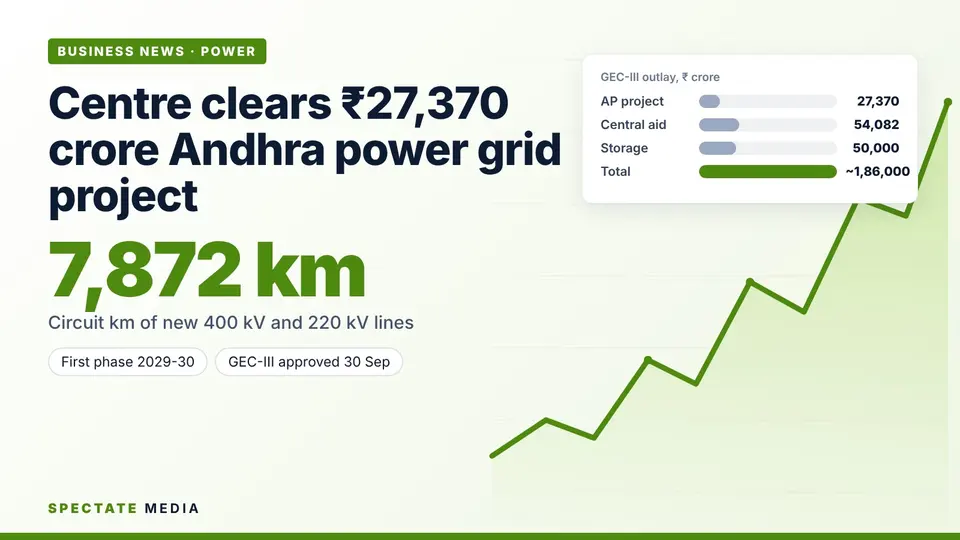
The Centre has approved a ₹27,370 crore power transmission project for Andhra Pradesh under the Green Energy Corridor Phase-III (GEC-III) scheme, Business Standard reported on 25 October 2026. The project was proposed by the Transmission Corporation of Andhra Pradesh, and the report attributes the timeline to a government source. Spectate Media has not seen the approval order and relies on the report.
What will be built
The project includes 7,872 circuit km of 400 kV and 220 kV lines and 9,500 MVA of substation capacity, including five new 400/220 kV substations. Pooling stations are planned at Mudigubba and Talupula, 5 GW each, and Porumamilla, 1 GW. New 400 kV substations are listed at Ramayapatnam and Koppaka. They would serve renewable energy zones in Anantapur, Sri Sathya Sai and Prakasam districts. The first phase is expected to be commissioned in 2029-30.
The national scheme
The Union Cabinet approved GEC-III on 30 September 2026, and the Andhra Pradesh component was pending until now. The scheme's outlay is ₹1.86 trillion, of which about ₹1.36 trillion is for intra-state transmission and ₹50,000 crore for 50 GWh of battery storage. Central assistance of ₹54,082 crore is meant to offset intra-state transmission charges. The target is to evacuate up to 135 GW of renewable energy by 2032-33.
Why the state needs it
A Central Electricity Authority estimate in the report puts Andhra Pradesh's peak demand at 30,927 MW in 2035-36, up from 15,600 MW in 2025-26. Without new renewable capacity and evacuation lines, unserved energy could reach 19.4% by 2035-36. As of March 2026, renewables made up 51% of installed capacity, about 16 GW, according to NITI Aayog data cited in the report, against a state potential of 237 GW. State targets for 2024 to 2029 include 78.5 GW of solar and 35 GW of wind.
Key numbers
- Project cost: ₹27,370 crore (Andhra Pradesh, GEC-III)
- Lines: 7,872 circuit km (400 kV and 220 kV)
- Substations: 9,500 MVA (Five new 400/220 kV)
- First phase: 2029-30 (Per a government source)
What boards and CFOs should note
Three points. First, the project is a long-dated one, with the first phase four to five years away. Second, central assistance is designed to lower transmission charges, which feed into the power purchase costs of distribution companies. Third, the report gives no contractor or award schedule, so procurement timing remains open.
Source: Business Standard, 25 October 2026. This is a summary of a news report, published as general information. It is not legal, tax or investment advice.
This article is journalism and commentary. It is not a recommendation to buy or sell any security, and it is not professional advice. Read the full disclaimer.