
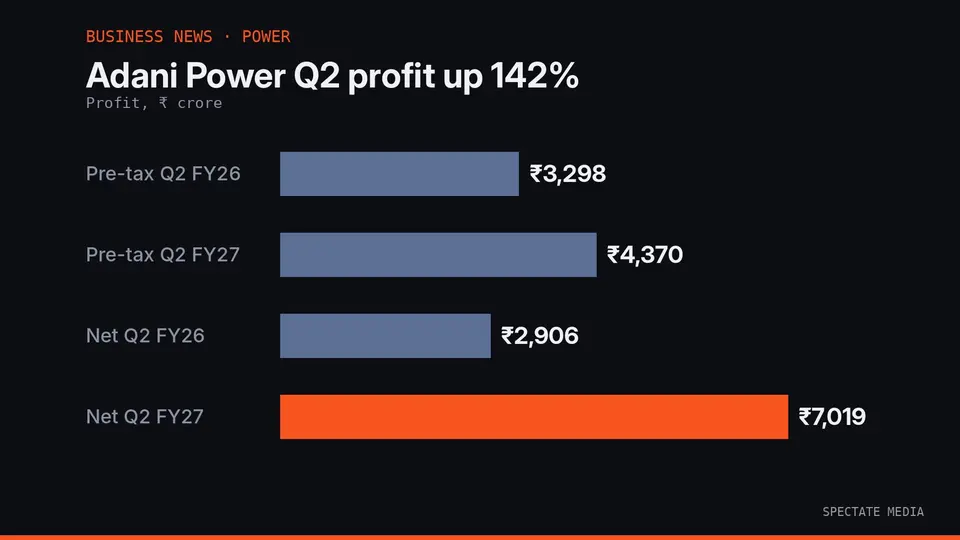
Adani Power reported a net profit of ₹7,019.32 crore for the second quarter of FY27, up about 142% from ₹2,906.46 crore a year earlier, according to Business Standard's report of 23 October 2026. Spectate Media has not seen the company's filing. An Economic Times headline gave consolidated profit as ₹6,919 crore, up 134%, with revenue up 45%, and Spectate Media could not open that article to see why the figures differ.
Profit and the one-off
Pre-tax profit was ₹4,369.51 crore, up 32.5% from ₹3,297.68 crore, which is a much smaller rise than the net profit figure. The report does not explain why net profit is higher than pre-tax profit. For the first half, net profit was ₹11,885.92 crore, up 91.4% from ₹6,211.59 crore. Finance costs fell 9.7% to ₹760.23 crore.
Revenue
Operating revenue was ₹17,014.06 crore, up 29.8% from ₹13,106.34 crore. It included one-time prior-period revenue of ₹2,422.25 crore, against ₹668.53 crore a year earlier. The company said this came mainly from revised historic energy charges under certain power purchase agreements. Management attributed revenue growth to higher volumes from stronger electricity demand, higher tariffs under power purchase agreements linked to sharply higher imported coal prices, and better merchant realisation.
Expansion
The company said it is progressing rapidly on a programme to add 23,720 MW of new thermal power capacity. The report gives no EBITDA, power sales volumes, installed capacity, plant load factor or debt figures.
Key numbers
- Net profit: ₹7,019.32 crore (Up about 142%)
- Pre-tax profit: ₹4,369.51 crore (Up 32.5%)
- Operating revenue: ₹17,014.06 crore (Up 29.8%; includes ₹2,422.25 crore one-off)
- New capacity planned: 23,720 MW (Thermal expansion programme)
What boards and CFOs should note
Three points stand out. First, the headline profit growth is far larger than the growth in pre-tax profit, and the report does not reconcile them. Second, a one-time ₹2,422 crore revenue item makes comparisons with other quarters harder. Third, the company links part of its tariff gains to imported coal prices, so fuel costs and tariffs move together in its explanation.
Source: Business Standard (PTI), 23 October 2026. This is a summary of a news report, published as general information. It is not legal, tax or investment advice.
This article is journalism and commentary. It is not a recommendation to buy or sell any security, and it is not professional advice. Read the full disclaimer.