Telangana has signed a state-led implementation agreement for the Amended BharatNet Programme, backed by ₹3,189 crore of central financial support and a network scope covering 12,769 gram panchayats.
The agreement brings together Digital Bharat Nidhi under the Department of Telecommunications, the Telangana government, Telangana Rural Internet Infrastructure Corporation, Bharat Sanchar Nigam Limited and Telangana Fiber Grid Corporation. TRIICL will implement the project.
The network scope
The programme includes 10,787 gram panchayats from BharatNet Phase II, 36 newly created gram panchayats and upgrades at 1,946 Phase I locations.
The Phase I work will move existing connections from a linear network to ring topology. A ring provides an alternative path when a link fails, improving resilience compared with a line in which one break can isolate downstream sites.
The project also aims to facilitate around three lakh rural home-fibre connections with government subsidy support. The release does not specify the subsidy per household, retail tariff or timetable for reaching that connection target.
Why the last mile matters
Building fibre to a gram panchayat does not automatically create active household or business connections. Local distribution, customer equipment, maintenance and affordable service plans determine whether backbone investment becomes usable broadband.
The agreement is intended to support e-governance, online education, telemedicine, digital payments and other citizen services. For small businesses, reliable connectivity can expand access to marketplaces, cloud tools and digital financial services, but adoption will depend on service quality and local support.
Key project numbers
- Central financial support: ₹3,189 crore
- Gram panchayats in scope: 12,769
- Phase II gram panchayats: 10,787
- Phase I sites to be upgraded: 1,946
- Newly created gram panchayats: 36
- Targeted rural home-fibre connections: about three lakh
What contractors and operators should watch
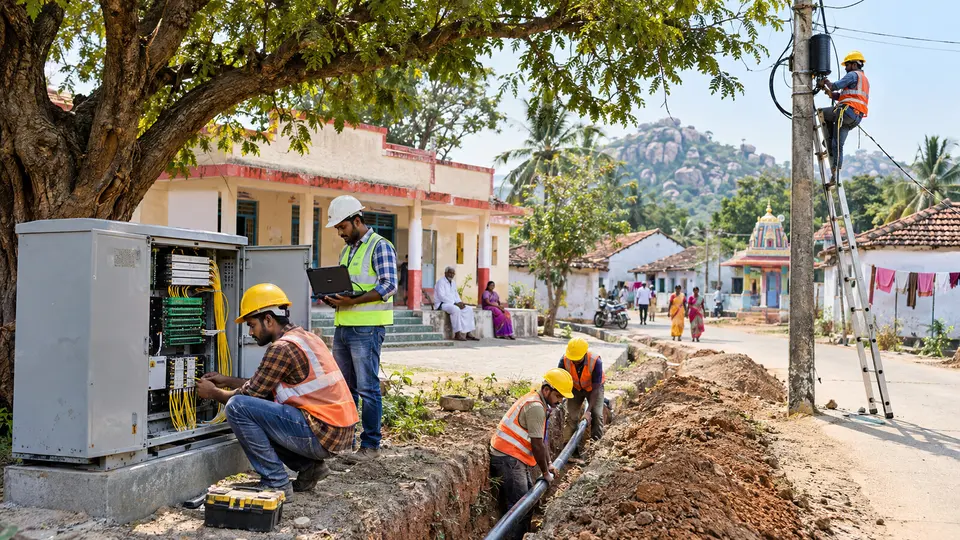
Execution will require coordinated civil works, fibre deployment, active equipment, power availability and network operations across a wide geography. Procurement schedules and right-of-way approvals will influence how quickly capital moves from sanction to commissioned links.
Operators should track uptime, fault-repair times and actual traffic rather than only premises passed. A resilient architecture adds value only when field maintenance and spare capacity support it.
For local internet providers and digital-service companies, the rollout could lower the infrastructure barrier to serving rural customers. Commercial opportunity will still depend on open access, wholesale pricing and clarity over which party manages each layer of the network.
Financing discipline will matter because the headline support covers a mix of new construction and upgrades. Public reporting should distinguish kilometres of fibre laid, gram panchayats technically connected and locations carrying live traffic. Treating those measures as interchangeable can overstate progress.
The home-connection target will also require demand creation. Training, local-language support and dependable installation appointments may be as important as the fibre itself for households using broadband for the first time.
The agreement marks an implementation milestone, not completion of the network. The next evidence points will be tender awards, commissioning milestones, active connections and measured service availability.
Source: Ministry of Communications release published by the Press Information Bureau on 6 November 2026.
This article is journalism and commentary. It is not a recommendation to buy or sell any security, and it is not professional advice. Read the full disclaimer.