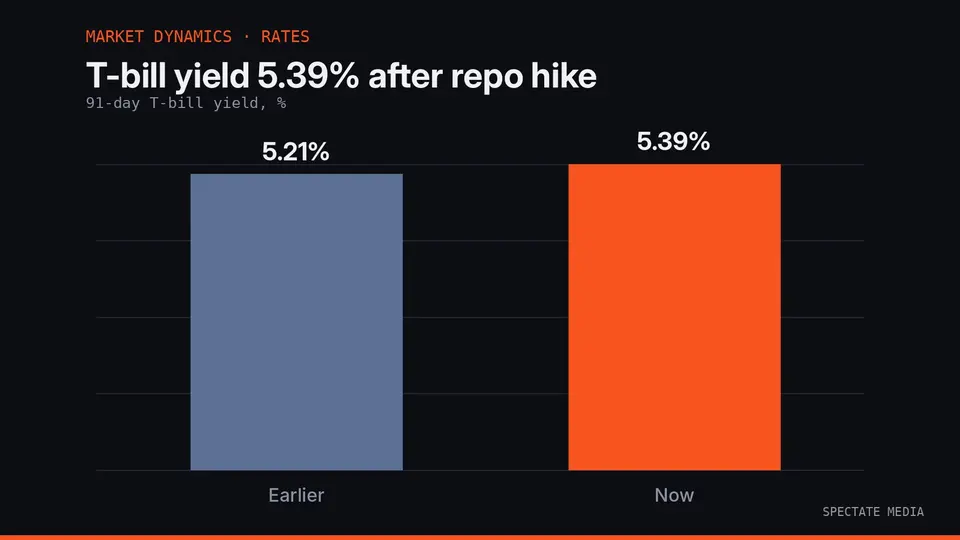
Short-term money-market yields have risen after the Reserve Bank of India raised the repo rate by 25 basis points to 5.50% on 7 October 2026, according to an Angel One News report updated on 17 October. The 91-day Treasury bill yield rose to 5.39% from 5.21%, an increase of 18 basis points. The lower end of certificate of deposit rates rose to 5.77% from 5.57%, an increase of 20 basis points. The report does not give the dates of the earlier readings.
Reading the numbers
On the report's figures, the 91-day T-bill yield sits 11 basis points below the new repo rate, and the low end of CD rates sits 27 basis points above it. The gap shows banks paying more for short-term funds than the government does.
What CareEdge expects
CareEdge expects the hike to pass into lending rates. Loans linked to an external benchmark would reprice first, and loans linked to the marginal cost of funds (MCLR) later, the report says.
Liquidity and growth
The report says higher funding costs and tighter liquidity could slow lending in the second half of the year. It cites bank credit growth of 19.38% to ₹230 trillion in the fortnight ended 30 September, which is covered in a separate Spectate Media report. It gives no sector-wise breakdown.
Key numbers
- Repo rate: 5.50% (Raised 25 bps on 7 October)
- 91-day T-bill yield: 5.39% (From 5.21%)
- CD rates, low end: 5.77% (From 5.57%)
- Move in T-bill yield: +18 bps (CDs up 20 bps)
What boards and CFOs should note
Three points stand out. First, floating-rate borrowers linked to an external benchmark should expect the first increase. Second, short-term funding is getting dearer for banks, which tends to raise the cost of working-capital lines over time. Third, the report is a secondary summary of the RBI data and does not cite the primary release.
Source: Angel One News, 17 October 2026. This is a summary of a news report, published as general information. It is not legal, tax or investment advice.
This article is journalism and commentary. It is not a recommendation to buy or sell any security, and it is not professional advice. Read the full disclaimer.