
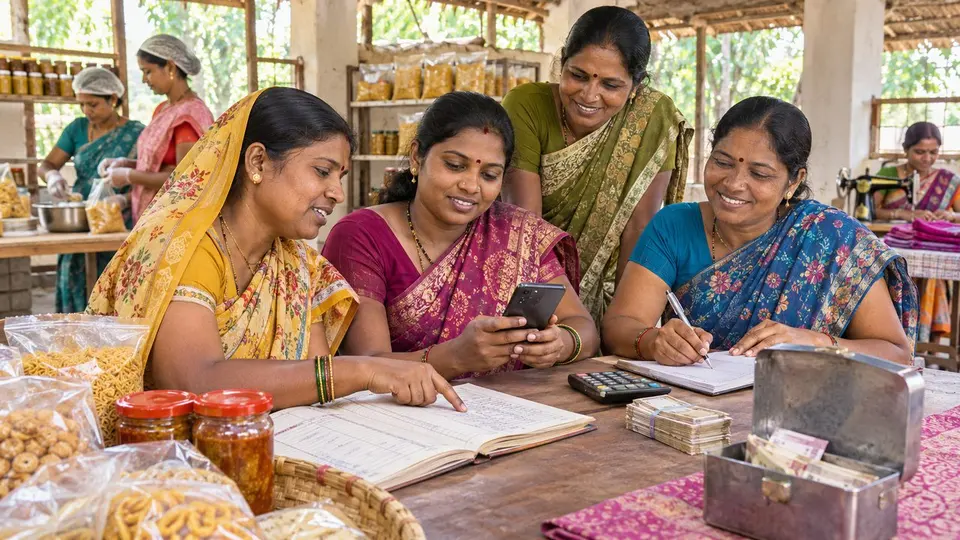
India’s Lakhpati Didi initiative had enabled 3.76 crore rural self-help-group women by June 2026, while identifying another 5.70 crore as potential participants for enterprise and livelihood support.
The programme now targets six crore Lakhpati Didis by March 2029. A qualifying member belongs to a household earning at least ₹1 lakh annually after expenses, with income expected to remain sustainable across seasons or business cycles.
Income and savings rose in an independent assessment
An assessment by IIM Ahmedabad covering 6,531 respondents across 17 states and Union Territories reported a 61% rise in average monthly household income and a 61.7% increase in average monthly savings among participating households.
Those findings indicate stronger household finances in the survey group, although programme-wide outcomes will depend on local enterprise mix, market access and the durability of earnings after support is provided.
The initiative operates through the Deendayal Antyodaya Yojana–National Rural Livelihoods Mission. As of 12 November, that network had mobilised about 10.13 crore women into 94.40 lakh self-help groups.
Community resource persons prepare household business plans and coordinate access to skills, finance, productive assets and markets. Digital tools record livelihoods and income, helping missions identify women who could reach the threshold with targeted support.
Enterprise quality matters more than the label
The programme’s scale creates potential demand for working capital, payments, insurance, equipment, logistics and buyer relationships. Private companies can participate through transparent sourcing arrangements and service partnerships that improve repeat sales rather than one-off exhibitions.
However, the ₹1 lakh benchmark is based on total household income, not necessarily the individual woman’s enterprise revenue. Comparisons should also account for local costs, farm income, seasonality and whether earnings remain stable.
The initiative reached one crore members in August 2024, two crore in August 2025 and its earlier three-crore target by December 2025. The new target substantially raises the delivery challenge.
Key numbers
Lakhpati Didis enabled: 3.76 crore Potential participants identified: 5.70 crore SHG members in DAY-NRLM: 10.13 crore Target for March 2029: Six crore
What boards and CFOs should note
- Buyers should assess enterprise capacity, quality control and fair-payment terms before scaling procurement.
- Financial providers can design products around seasonal cash flows rather than uniform monthly assumptions.
- Impact claims should distinguish household income, individual earnings, revenue and profit.
Source: Press Information Bureau, 15 November 2026. This is a summary of official material and general information, not investment advice.
This article is journalism and commentary. It is not a recommendation to buy or sell any security, and it is not professional advice. Read the full disclaimer.