
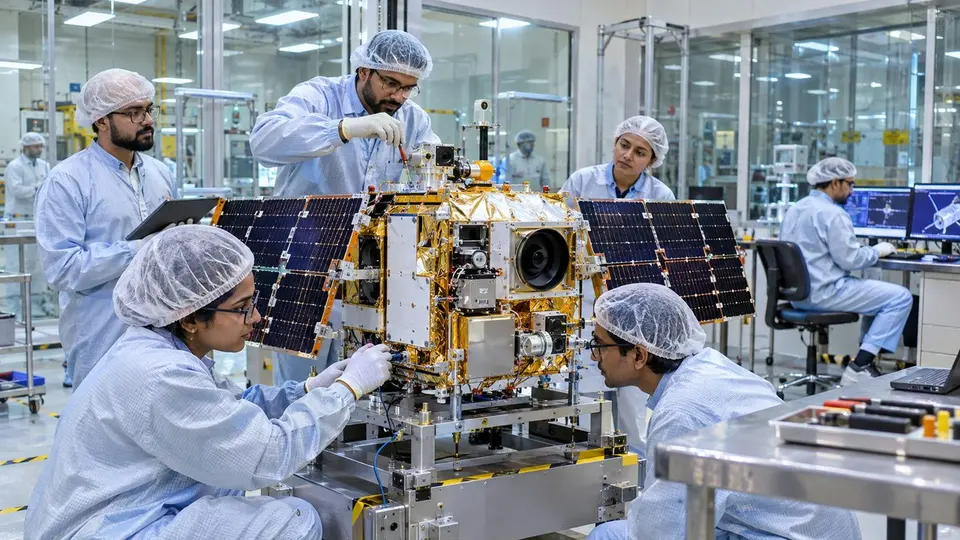
India’s registered space start-up base expanded from one company in 2014 to about 440 by August 2026, as policy reforms opened launch, satellite, data and infrastructure activities to private participation.
The domestic space economy was estimated at roughly $9 billion in August, compared with about $8.4 billion in 2023. Cumulative investment in Indian space start-ups reached $618.5 million by 31 March 2026, up from $100.5 million in 2021-22, according to a government backgrounder published on 15 November.
A wider commercial value chain
The 2020 space reforms allowed non-government entities to participate across the value chain rather than remain component suppliers. The Indian Space Policy 2023 subsequently clarified institutional roles, while IN-SPACe became the single-window body for authorisation and access to public facilities.
By mid-2026, IN-SPACe had granted 113 authorisations to 52 non-government entities, including 18 start-ups. It had also facilitated 71 technology transfers to industry and start-ups by January.
NewSpace India Limited, the commercial arm of the Department of Space, recorded revenue of more than ₹3,000 crore in 2024-25, against ₹321.77 crore in 2021-22. It signed 118 transfer agreements covering 83 ISRO technologies.
Private operators are moving from demonstrations into missions. Six Indian non-government entities had launched 18 satellites, while 25 payloads had flown or were scheduled on PSLV Orbital Experimental Module platforms.
Capital must translate into repeatable businesses
Start-up and investment counts show activity, not commercial durability. Companies still need recurring customers, reliable launch schedules, insurance, spectrum access and compliance with safety, security and orbital-debris requirements.
The government had received 11 foreign-investment proposals worth ₹1,745.40 crore for the space sector by mid-2026. Liberalised ownership rules can widen funding and technology access, but approvals and national-security safeguards remain material to deal timelines.
Commercial opportunities span satellite manufacture, launch services, geospatial analytics, communications, navigation and downstream applications. The strongest businesses will be those that turn specialist engineering into dependable services with identifiable buyers rather than relying only on demonstration grants.
Key numbers
Registered space start-ups: About 440 Estimated space economy: About $9 billion Start-up investment: $618.5 million IN-SPACe authorisations: 113
What boards and CFOs should note
- Customers should assess mission reliability, licensing and data-security obligations before depending on a young supplier.
- Investors need to model long development cycles and concentrated launch or government-customer risk.
- Industrial groups can evaluate technology-transfer and downstream-data partnerships without building full launch capabilities.
Source: Press Information Bureau, 15 November 2026. This is a summary of official material and general information, not investment advice.
This article is journalism and commentary. It is not a recommendation to buy or sell any security, and it is not professional advice. Read the full disclaimer.