
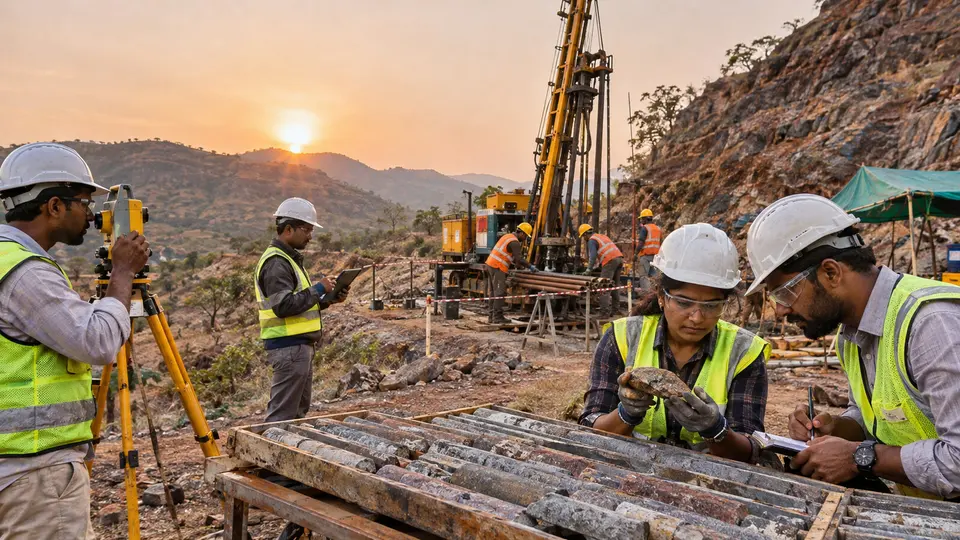
India has opened bidding for 20 critical and strategic mineral blocks and 11 exploration-licence blocks, while changing auction rules to reduce the risk that assets remain unsold for lack of qualified bidders.
The ninth critical-mineral tranche covers resources including graphite, rare earth elements, tungsten, vanadium, gallium, titanium, scandium, potash and halite across eight states. The third exploration-licence tranche spans copper, vanadium, rare earth elements, potash and associated mineralisation.
The bidder threshold has changed
Under the Mineral (Auction) Third Amendment Rules, 2026, the minimum number of technically qualified bidders required for the second round has been reduced from three to two for Part D minerals.
The government said insufficient bidder numbers had been a reason some blocks were not awarded. Letters of Intent will also be issued automatically through the Unified Mining Portal, reducing a manual step after auction completion.
Two auction models
Critical-mineral blocks offered through composite licences or mining leases will use a two-stage ascending forward auction. The qualified bidder offering the highest percentage of revenue share wins.
Exploration licences use a two-stage descending reverse auction. The winner offers the lowest percentage share from the future mining lessee’s revenue, creating an incentive to conduct early-stage exploration efficiently.
Exploration licences were introduced under Section 10BA of the Mines and Minerals (Development and Regulation) Act for 29 critical and deep-seated minerals. They allow private companies to explore before a mining project is established.
Auction record and deadlines
The previous eight critical-mineral tranches offered 100 unique blocks, of which 64 were auctioned successfully. Two earlier exploration-licence rounds awarded 11 blocks.
- Critical-mineral blocks in tranche nine: 20
- Exploration-licence blocks in tranche three: 11
- Previous critical-mineral auction success rate: 64%
- Tender-document purchase deadline: 1 January 2027, 5 PM IST
- Bid-submission deadline: 7 January 2027, 5 PM IST
What bidders should assess
Mining and exploration companies should evaluate geological confidence, access, environmental obligations and the capital required to move from resource identification to production. Winning a block does not eliminate permitting, land or infrastructure risk.
The two-bidder threshold may improve auction completion, but it also makes transparent qualification and price discovery more important. Boards should test revenue-share bids against conservative commodity-price and recovery assumptions rather than strategic enthusiasm alone.
Manufacturers in batteries, electronics, fertilisers, defence and advanced materials will watch whether the auctions translate into domestic supply. Exploration results, mine development and processing capacity will determine the eventual reduction in import dependence.
State governments will influence execution because roads, water, power and local clearances shape project economics. Early engagement with communities and transparent environmental baselines can reduce later disputes, though they cannot substitute for formal consent and statutory review.
Prospective exploration bidders should also examine how their future revenue share is calculated and audited. A low bid may win the licence, but the business still needs enough value from discovery work to fund technically demanding surveys and drilling programmes.
This auction is distinct from the recently approved capital-subsidy programme for lithium and nickel processing: one targets resource access, while the other supports downstream plants.
Source: Ministry of Mines release published by the Press Information Bureau on 5 November 2026.
This article is journalism and commentary. It is not a recommendation to buy or sell any security, and it is not professional advice. Read the full disclaimer.