The Union Cabinet has approved a ₹2,814-crore capital-support scheme for domestic processing of lithium and nickel, seeking to reduce India’s dependence on imported refined materials and strengthen supply chains for batteries, electronics, defence and speciality steel.
The programme will run from FY2026-27 to FY2030-31. It targets four commercial-scale plants: two lithium-processing facilities with minimum capacity of 30 kilotonnes each and two nickel-processing facilities with minimum capacity of 50 kilotonnes each.
Capital subsidy is set at 30%
Eligible projects can receive a subsidy equal to 30% of qualifying investment. Support is capped at ₹500 crore for each lithium beneficiary and ₹900 crore for each nickel beneficiary.
Beneficiaries will be selected in two stages. Applicants must first clear a technical qualification assessment. Qualified bidders will then compete on the lowest capital support sought, with two beneficiaries selected for each mineral.
Payments will be released in three tranches linked to specified project milestones. The structure is intended to tie public funding to actual construction and operational progress rather than disburse the subsidy entirely upfront.
Scheme targets a supply-chain gap
India remains substantially dependent on imports of refined intermediates and high-purity critical-mineral materials. The government said domestic projects face high capital requirements, limited access to processing technology and constraints in securing raw material.
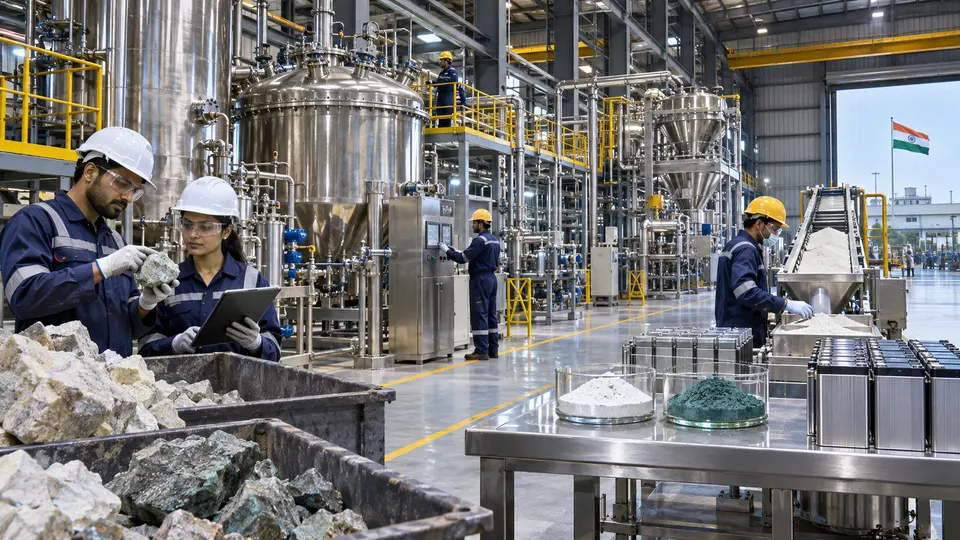
The supported plants will process lithium and nickel ores or intermediary products into high-purity compounds. Cobalt may also be recovered as a by-product of nickel production.
Downstream sectors are the strategic focus
Lithium, nickel and cobalt are central inputs for electric mobility and battery energy-storage systems. They are also used across electronics, defence and advanced industrial applications. Increasing domestic processing capacity could add resilience between imported or mined raw material and Indian manufacturing demand.
The release does not identify project locations, bidders, technology providers or raw-material sources. Those choices will shape execution risk, environmental approvals, operating costs and the programme’s eventual effect on import substitution.
Key numbers
- Total scheme outlay: ₹2,814 crore
- Programme period: five financial years
- Planned plants: four
- Capital subsidy: 30% of eligible investment
- Lithium capacity floor: 30 kt per plant
- Nickel capacity floor: 50 kt per plant
Source: Press Information Bureau, 4 November 2026. This is general information, not investment, tax or legal advice.
This article is journalism and commentary. It is not a recommendation to buy or sell any security, and it is not professional advice. Read the full disclaimer.