India has prohibited the export of lithium-ion battery black mass, a processed recycling feedstock containing recoverable critical minerals, in a move intended to strengthen the country’s domestic battery-recycling chain.
The Directorate General of Foreign Trade changed the export policy for the relevant tariff line from “Free” to “Prohibited” through Notification No. 49/2026-27 dated 10 November. The restriction took effect immediately and will remain in place until further orders.
Recycling feedstock becomes strategic
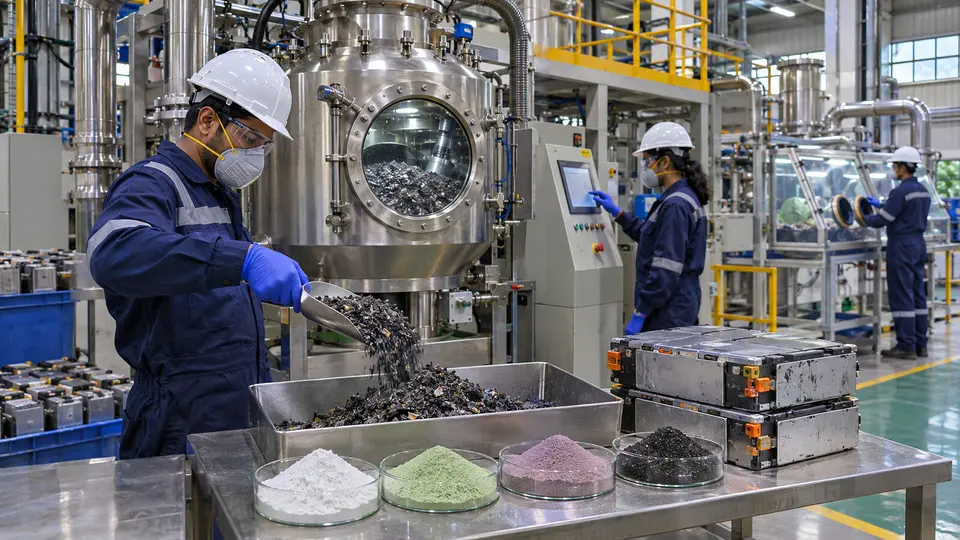
Black mass is produced after used lithium-ion batteries are discharged, dismantled and mechanically processed. It can contain lithium, cobalt, nickel, manganese and graphite, with the exact composition depending on battery chemistry and processing quality.
Keeping this material in India can improve feedstock availability for domestic hydrometallurgical and other mineral-recovery facilities. That is important because new recycling plants need predictable volumes to operate efficiently, while manufacturers are seeking more secure supplies of battery materials.
The prohibition complements the government’s ₹1,500 crore incentive scheme for recycling critical minerals. Together, the measures point to a policy preference for extracting more value from end-of-life batteries inside India rather than exporting a semi-processed resource.
A business opportunity with execution risks
For recyclers, the near-term opportunity is greater access to raw material and a clearer case for investment in collection, pre-processing and recovery capacity. Equipment makers, traceability providers and specialised logistics companies may also benefit as the formal recycling ecosystem expands.
However, an export ban alone cannot guarantee viable recycling economics. Collection from dispersed users, safe transport, battery identification, environmental compliance and transparent pricing remain critical. If informal handling persists or recovery yields are poor, the available black mass may not translate into high-quality domestic mineral output.
The policy also increases the importance of standards and auditable material flows. Producers and recyclers will need systems that can track batteries from collection through processing and document recovered materials.
India’s emerging battery economy is increasingly treating waste as a strategic resource. The test now is whether recyclers can turn retained feedstock into reliable, competitively priced minerals for domestic industry.
Source: Press Information Bureau and Directorate General of Foreign Trade, 11 November 2026.
This article is journalism and commentary. It is not a recommendation to buy or sell any security, and it is not professional advice. Read the full disclaimer.