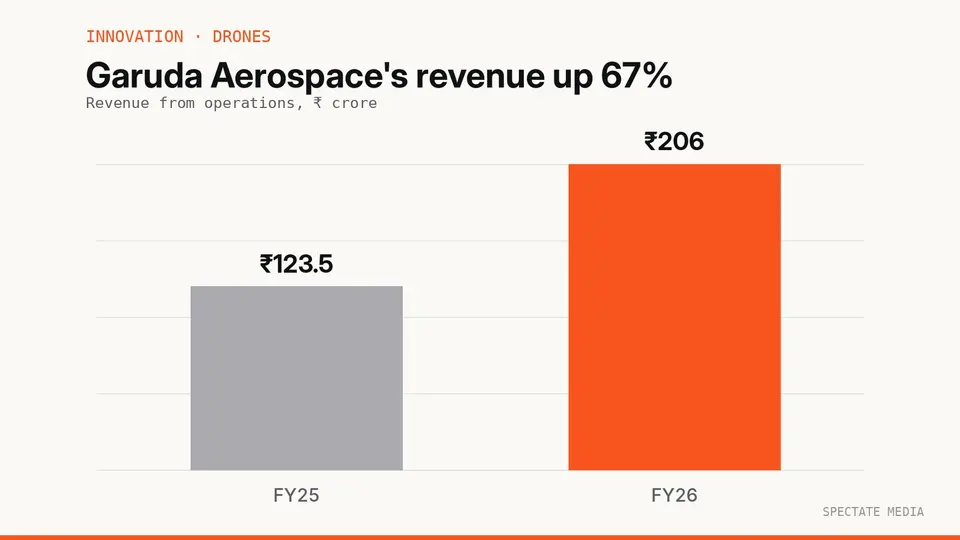
Garuda Aerospace, a Chennai-based drone company, reported revenue from operations of ₹206 crore for FY26, up 67% from ₹123.5 crore in FY25, according to Entrackr's report of 23 October 2026. The report is based on financial statements filed with the Registrar of Companies. Spectate Media has not seen the filings. Net profit was about ₹26 crore, up 41.5% from ₹18.37 crore. Inc42 gave the profit as ₹25.9 crore and the growth as 41%, so the exact figure differs slightly between reports.
Where the revenue came from
Revenue from services was ₹106.46 crore, up 84.1% from ₹57.83 crore, and revenue from products was ₹99.50 crore, up 66.2% from ₹59.85 crore. The company designs and makes drones for agriculture, defence, infrastructure, mining and disaster management. It also sells drone-as-a-service and runs a remote pilot training programme approved by the DGCA.
Costs and returns
Total expenses rose 73.7% to ₹172 crore, from ₹99 crore. Cost of materials was the largest item at ₹117 crore, up 62%. Employee costs fell 16.2% to ₹8 crore, and legal and professional charges rose 94.6% to ₹12.88 crore. Entrackr reported an EBITDA margin of 18.97% and a return on capital employed of 14.71%. Each rupee of operating revenue cost ₹0.83 in FY26, up from ₹0.80. Current assets were ₹303 crore at the end of March 2026, up from ₹176 crore, and cash and bank balances were ₹5.2 crore.
The IPO
The company has received SEBI approval for an IPO of ₹1,000 crore, made up of a fresh issue of ₹750 crore and an offer for sale of ₹250 crore by existing shareholders. Its draft prospectus was pre-filed confidentially in April, and the report does not state the year.
Key numbers
- FY26 revenue: ₹206 crore (Up 67% from ₹123.5 crore)
- FY26 net profit: About ₹26 crore (Up 41.5%; Inc42 says ₹25.9 crore)
- Services revenue: ₹106.46 crore (Up 84.1%)
- Planned IPO: ₹1,000 crore (SEBI approval received)
What boards and CFOs should note
Three points stand out. First, growth in services outpaced products, which points to demand for drone operations as well as hardware. Second, costs grew faster than revenue, so cost per rupee of revenue edged up. Third, the cash balance is small against current assets, which is worth reading alongside the IPO plan.
Source: Entrackr, 23 October 2026. This is a summary of a news report, published as general information. It is not legal, tax or investment advice.
This article is journalism and commentary. It is not a recommendation to buy or sell any security, and it is not professional advice. Read the full disclaimer.