Agrograde, an Indian startup that builds AI and automation machines for agricultural packhouses, has deployed an optical sorter for arecanut at Vikas Traders in Mangaluru, Karnataka, according to The Machine Maker on 19 October 2026. It is described as the system's first commercial installation. Spectate Media has not seen the company's own release, and the accuracy figures are the company's.
How it performs
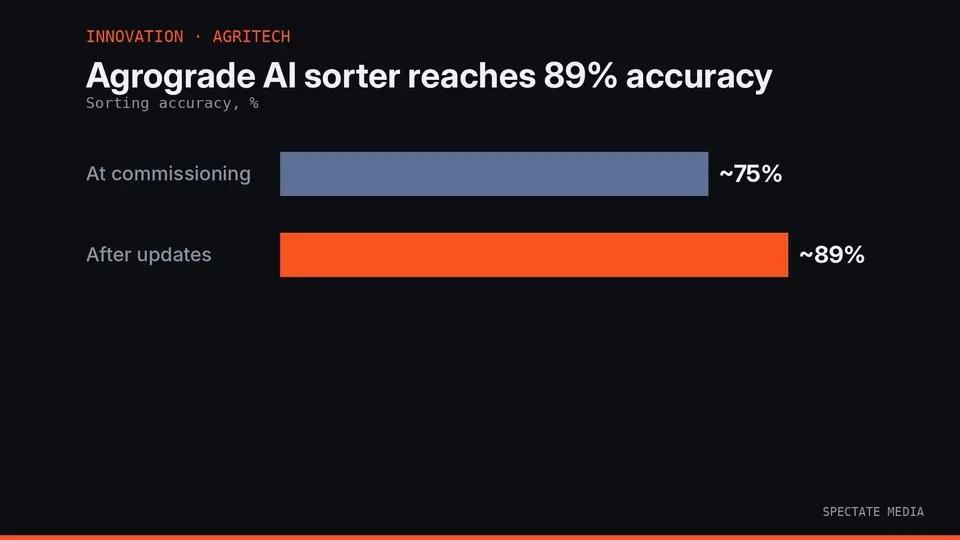
The machine handles about one tonne of arecanut an hour, or close to eight tonnes a day. Accuracy was about 75% when it was first commissioned and about 89% after the AI models were updated with operating data. The company expects further gains as more data builds up. Computer vision inspects each nut for external defects that colour-based sorters can miss, and rejected nuts are separated automatically. The system captures 10 to 12 images of each nut, and a patent-pending "Vector" design improves surface coverage. Each lot receives a quality report on size distribution and defects.
What it replaces
Before automation, Vikas Traders relied heavily on manual sorting. One worker sorted about two bags a day, and a team of about 15 workers processed 40 to 45 bags a day. Those figures do not fully reconcile, since 15 workers at two bags each is 30, so treat them as approximate. Development took about five months and three product iterations. The article gives no price or return on investment.
The company
Agrograde says it has deployed its 150th machine across 15 states. It also works on onions, potatoes and apples. YourStory carried the same announcement in its 21 October roundup.
Key numbers
- Accuracy after model updates: About 89% (Company-reported)
- Accuracy at commissioning: About 75% (First installation)
- Throughput: About 1 tonne an hour (Near 8 tonnes a day)
- Images per nut: 10 to 12 (Analysed in milliseconds)
What boards and CFOs should note
Three points stand out. First, a gain from 75% to 89% came from model updates after installation, not new hardware. Second, claims of accuracy are the company's and are not independently verified. Third, with no pricing disclosed, the economics against manual sorting cannot yet be judged.
Source: The Machine Maker, 19 October 2026. This is a summary of a news report, published as general information. It is not legal, tax or investment advice.
This article is journalism and commentary. It is not a recommendation to buy or sell any security, and it is not professional advice. Read the full disclaimer.