
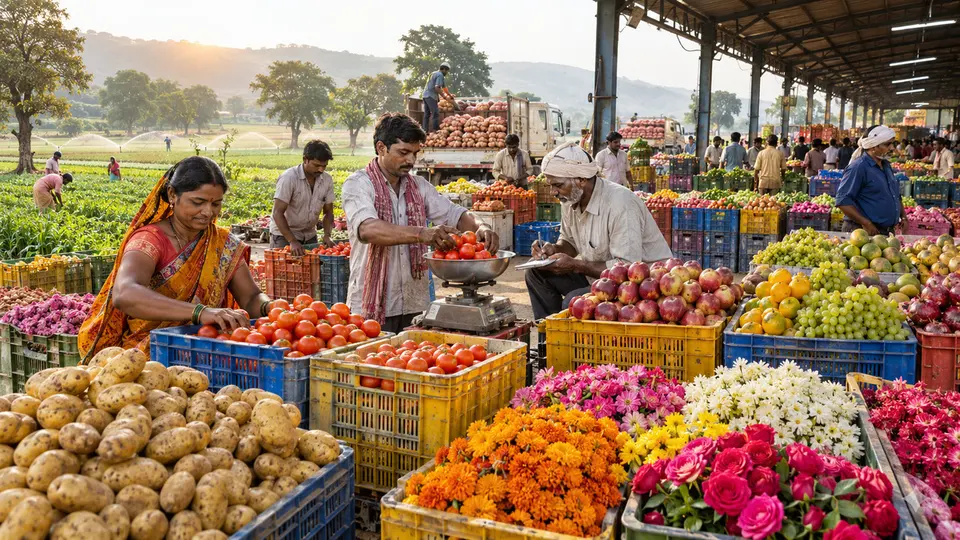
India’s horticulture production is estimated to reach a record 386.9 million tonnes in 2025-26, according to the government’s third advance estimates.
That is 16.18 million tonnes, or 4.36%, above the previous year’s 370.7 million tonnes. The increase is expected even as the area under horticultural crops declines to about 29.72 million hectares from 30.14 million hectares.
More output from a smaller cultivated area
The combination of higher production and lower area points to improved aggregate productivity, although crop and regional outcomes will vary. The estimates are compiled from information supplied by states, Union Territories and other government agencies and can still be revised.
Fruit production is projected to rise 4.60% to 123.07 million tonnes, supported by crops including banana, mango, papaya, apple and pomegranate.
Vegetable output is estimated at 227.27 million tonnes, 4.35% higher than the previous year. Potato production is projected to rise 11.95% to 65.57 million tonnes, while tomato output is expected to reach 21.41 million tonnes. Onion production is estimated at 28.90 million tonnes.
Flower output shows the fastest headline increase among the main groups. Production is projected to grow 14.45% to 4.88 million tonnes, with the cultivated area rising to 410,000 hectares.
Supply-chain capacity will shape the economic effect
Higher horticulture output can support farm incomes, food processing, cold storage, transport and exports. It can also put pressure on prices when harvesting exceeds the capacity to store, process or move perishable produce.
The commercial effect therefore depends on more than tonnage. Farmers need reliable market access, grading, refrigerated logistics and processing demand. Buyers need consistent quality and predictable volumes, while local infrastructure must reduce losses between the farm and consumer.
Plantation-crop output is estimated to rise 7.56% to 18.26 million tonnes. Spice production is projected at 12.35 million tonnes, supported by crops such as turmeric, garlic, curry leaves and cardamom.
Advance estimates are an important supply signal, not a final measure of realised output or farmer earnings. Weather, post-harvest losses and market prices will determine how much of the projected production translates into economic value.
Source: Ministry of Agriculture and Farmers Welfare via PIB, 17 November 2026.
This article is journalism and commentary. It is not a recommendation to buy or sell any security, and it is not professional advice. Read the full disclaimer.