
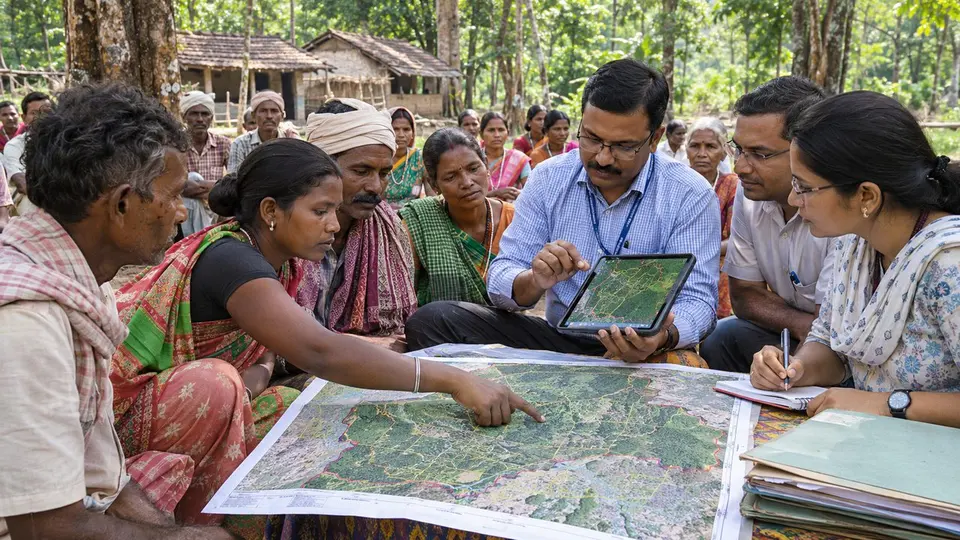
India has launched a national digital platform to bring the Forest Rights Act claims process—from submission before the Gram Sabha to a digitally signed title—onto one system.
The Ministry of Tribal Affairs said about 54 lakh claims had been received by 31 August 2026. Of these, 43.56 lakh, or 80.64%, had been disposed of, while 25.42 lakh titles had been distributed across nearly 238 lakh acres.
Digitisation covers five stages
The platform is designed around the statutory process under the Forest Rights Act, 2006. Claims begin with the Gram Sabha and move through verification, sub-divisional scrutiny and district-level decision before a title is issued.
Digitising the workflow can create a common record of applications, maps, decisions and signed titles. It may also make delays and missing documentation easier to identify, provided states maintain accurate records and officials update each stage consistently.
The current title count comprises 24.18 lakh individual titles and 1.24 lakh community titles. Chhattisgarh has distributed the largest number, followed by Odisha, Madhya Pradesh, Telangana and Andhra Pradesh.
Titles are heritable but cannot be sold or transferred. Entering recognised rights in revenue and forest records can help title holders access agriculture, fisheries and livelihood schemes.
Digital records do not replace due process
The law gives Gram Sabhas a central role in receiving and verifying claims. Technology must preserve participation, reasoned decisions and appeal rights rather than reduce the process to a database exercise.
The ministry has stressed that rejected claims require orders stating reasons. Claimants can petition the next committee within the prescribed period, so digital notices and accessible records will be material to procedural fairness.
Implementation covers 20 states and Jammu and Kashmir. The next tests are state adoption, integration with land records, mapping quality, cybersecurity and the resolution of pending claims.
Key numbers
Claims received: About 54 lakh Claims disposed: 43.56 lakh Titles distributed: 25.42 lakh Area covered: Nearly 238 lakh acres
What boards and CFOs should note
- Projects near forest land need title and community-rights due diligence alongside conventional land records.
- Procurement and livelihood programmes should recognise Gram Sabha authority and documented community rights.
- Digital availability does not remove consultation, consent or appeal obligations under applicable law.
Sources: Ministry of Tribal Affairs via PIB and the National FRA Digital Platform. This is general information, not legal advice.
This article is journalism and commentary. It is not a recommendation to buy or sell any security, and it is not professional advice. Read the full disclaimer.