
India and Egypt will establish a joint working group to explore the terms of reference for a preferential or free trade agreement, opening a formal route toward deeper market access between the two economies.
The decision came at the seventh India–Egypt Joint Trade Committee meeting, held at ministerial level for the first time. The two countries are targeting $12 billion in bilateral trade and want to diversify beyond the existing basket.
Trade rose 35% to $6.5 billion in 2025-26. It reached $5.04 billion in the first half of 2026-27, up 65% from $3.08 billion a year earlier, according to India’s commerce ministry.
Manufacturing partnerships move into focus
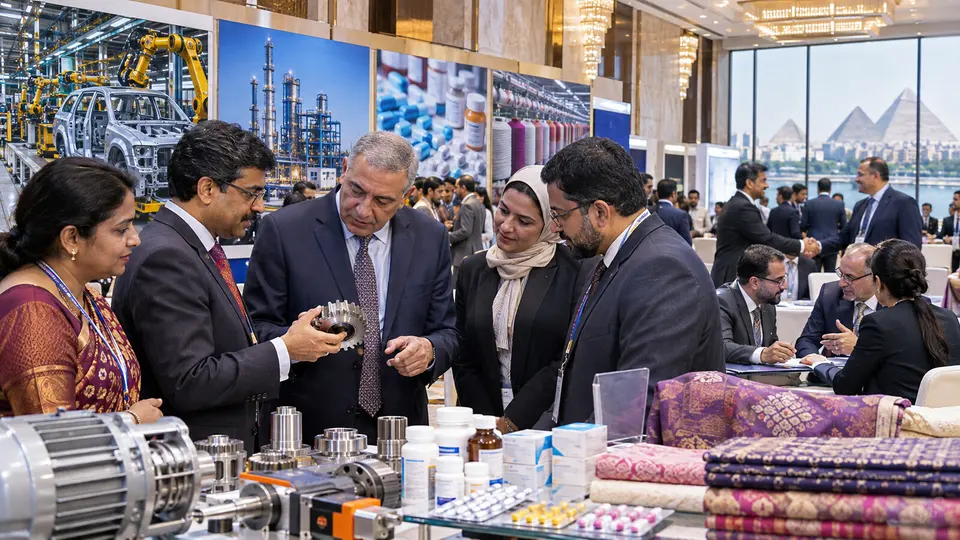
More than 300 Indian and Egyptian companies joined a related business forum covering industrial goods, energy and fertilisers, chemicals, pharmaceuticals, engineering, textiles and agricultural products.
For Indian exporters, Egypt offers a sizeable domestic market and a manufacturing base connected to Africa, West Asia and Europe. Egyptian businesses can use closer ties to expand sourcing, technology partnerships and access to India’s consumer and industrial markets.
A trade agreement could lower tariffs, simplify customs processes and make investment more predictable. However, the working group is only an initial step. Negotiators must still define product coverage, rules of origin, services commitments, standards and safeguards before any commercial preferences take effect.
Growth needs broader and more durable flows
Rapid headline growth can reflect commodity prices or a few large product categories. A resilient partnership would require a wider mix of firms, more value-added trade and investment that creates supply chains in both countries.
Businesses should therefore treat the announcement as a signal to map opportunities, not as an immediate tariff change. Existing duties, standards and licensing requirements remain in force unless governments complete negotiations and implement a pact.
The committee also discussed trade-related obstacles and long-term industrial links. Whether the $12 billion target is reached will depend on execution: regular business matchmaking, finance and logistics support, and a negotiating process that converts political intent into usable market access.
Source: Ministry of Commerce and Industry via PIB, 16 November 2026.
This article is journalism and commentary. It is not a recommendation to buy or sell any security, and it is not professional advice. Read the full disclaimer.