
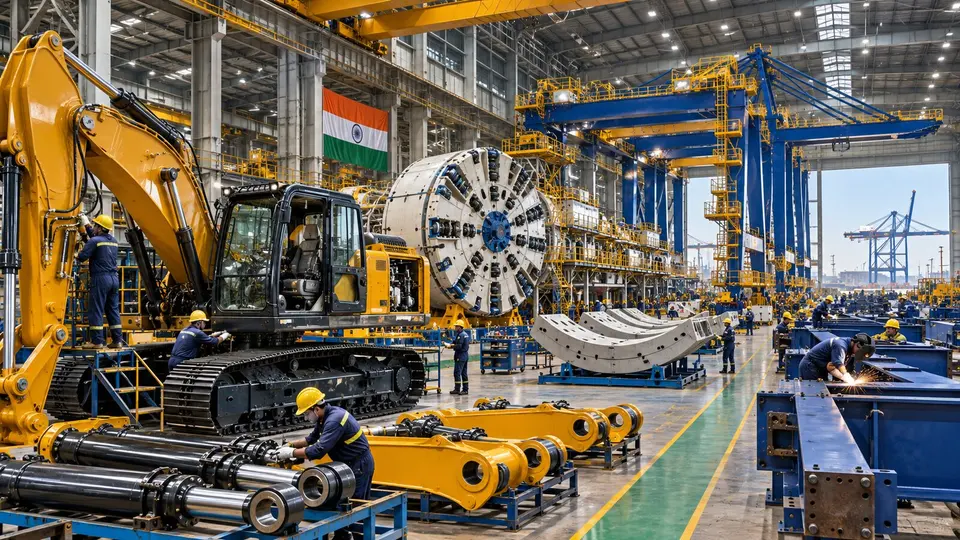
The Union Cabinet has approved an Rs 11,000 crore programme to build a stronger domestic manufacturing ecosystem for construction and infrastructure equipment.
Administered by the Ministry of Heavy Industries, the eight-year scheme combines sales-linked incentives for eligible manufacturers with support for common testing facilities. Incentive rates begin at 13% and taper to 8%, while a testing facility can receive a grant of up to Rs 375 crore.
A large market with a localisation gap
India is the world's third-largest construction and infrastructure equipment market. The sector was valued at about Rs 97,500 crore in 2024-25 and is projected to reach Rs 2.28 lakh crore by 2029-30, according to the government.
That expansion is being driven by roads, railways, urban works, mining and energy projects. The new scheme seeks to retain more of the resulting value inside India by encouraging local production of machines, components and specialised systems.
The design matters because heavy-equipment supply chains require more than assembly. Competitive manufacturing depends on hydraulics, powertrains, precision fabrication, electronics, controls, tooling and certification capacity.
Incentives will be tested by execution
Sales-linked support can improve the economics of new capacity, but durable gains will depend on whether firms build local vendor networks and export-capable products. Shared testing infrastructure could lower certification costs for smaller manufacturers and shorten product-development cycles.
The most important measure of success will be a sustained decline in import dependence alongside higher domestic value addition. A larger local ecosystem could also make infrastructure projects less exposed to external supply disruptions and long delivery times.
This article is journalism and commentary. It is not a recommendation to buy or sell any security, and it is not professional advice. Read the full disclaimer.